Friday, 30 June 2023

All about Districts of Western Rajasthan


 There are 50 districts in Rajasthan in total when there is new 19 districts are announced today by the CM of Rajasthan, So Now the overall number of districts in Rajasthan is 50. Each district is headed by a District Magistrate with the support of a Superintendent of Police. These districts are categorized under 7 different divisions of Ajmer, Kota, Jaipur, Bharatpur, Bikaner, and Udaipur. The districts of Rajasthan are segregated under separate divisions for ease of administration.

The newest district added to the state of Rajasthan is Pratapgarh. It was added as a new district in the state in 2008. We have shared all the names of the districts of Rajasthan here, along with details of the area covered and the total population.

Districts of western part of Rajasthan comprises of the districts like Jaisalmer District, Bikaner District and Barmer District.

Jaisalmer District

Jaisalmer District is a district of Rajasthan. The city of Jaisalmer is the administrative headquarters of the district. Jaisalmer was an important trading centre during Rajputana Regime. Jaisalmer Fort, Patwon Ki Haveli, Salim Singh ki Haveli, Sam Sand Dunes, Bada Bagh and Gadisar Lake are popular tourism destinations in Jaisalmer. Jaisalmer Fort is also known for the rich history of Rajputs. It is known as “The Golden City”. This medieval town stands on a ridge of yellowish sandstone, crowned by a fort, which contains the palace and several ornate Jain temples. Many of the houses and temples are finely sculptured. It lies in the heart of the Thar Desert and has a population of about 78,000. Jaisalmer is an arid desert region in Rajasthan. It is prone to extremes in terms of temperature. The temperature of Jaisalmer varies greatly from day to night in both summer and winter. The maximum summer temperature of Jaisalmer is around 49 degree celsius while the minimum is 25 degree Celsius. The maximum winter temperature is usually around 23.6 degree Celsius and the minimum is 5 degree celsius.

Bikaner District

Bikaner District is a district of the state of Rajasthan. The historic city of Bikaner is the district headquarters. Bikaner is also administrative division with the four districts like Bikaner District, Churu District, Sri Ganganagar District and Hanumangarh District. Bikaner is popular for Laxmi Niwas Palace. It is now turned into a heritage hotel. Bikaner is situated in the middle of the Thar Desert and has a hot semi-arid climate. Bikaner is well served with roads and railheads and is linked directly to Delhi, Jaipur, Agra, Alwar, Ludhiana, Sriganganagar, Bhatinda, Ambala, Ahmedabad, Haridwar, Jodhpur and many other cities of north India and western part of India.

Barmer District

Barmer District is a district in Rajasthan state of India. It is located in the western part of Rajasthan state forming a part of the Thar Desert. Barmer is the third largest district by area in Rajasthan and fifth largest district in India. Barmer District has the district headquarters- town of Barmer. The other major towns in the district are Balotra, Guda Malani, Baytoo, Siwana, Jasol and Chohatan. Barmer is located in the western part of the state forming a part of the Thar Desert. The district borders Jaisalmer district in the north, Jalore district in the south, Pali district and Jodhpur district in the east, and Pakistan in the west. Siwana fort is a very old fort, estimated at over a thousand years old. It is a popular destination there.
Thursday, 29 June 2023

Gates of Delhi

 Gates of Delhi were built by different rulers belonging to different dynasties. Ajmeri Gate, Turqman Gate, Delhi Gate, Nigambodh Gate, Bahadur Shahi Gate, Khooni Darwaza, are some of the famous gates here.

Gates in the First City
In the first city of Delhi, 13 gates were built in the 11th century citadel of Lal Kot. However, only a few of them remain now. These are the Chaumukha, Sohan, Ranjit, Fateh, Hauz Rani, Barka, Badaun and Budayuni gates. Among these the Chaumukha, Ranjit, Sohan and Fateh darwazas are regarded as heritage monuments by the INTACH.
The Chaumukha Darwaza, is the gate way of Lal Kot. It is located close to the Qutub Complex and is conserved by the Archaeological Survey of India. That architectural style of the gate belongs to the Tuglaq period. The Ranjit gate located towards the north wall of Lal Kot is in ruined state now. It is through this gate that the Turks had entered the city. Presently only part of the gate can be seen. The Fateh Gate has been made in a complicated way and is about 24 m in diameter. The Sohan Gate here is guarded by a large bastion. Hauz Rani and Budayuni Gates, which were once prominent gates, are now in ruins. The Budayuni gate was earlier the chief gate of the city by Ibn Battuta. It is here that Ala-ud-din Khilji broke all his wine caskets and shunned drinking. The guilty were also punished here. Ala-ud-din Khilji wanted to build four darwazas (gates). He could however build only one, the Alai Darwaza. It has a wide and bulging dome and is built of red sandstone.
Gates of Second City
The second medieval city comprises of the Siri Fort. It was built during the reign of Ala-ud-Din Khalji of the Delhi Sultanate. It was built to protect the city from the terror of the Mongols. When the city was built it was adorned with palaces and other rich structures. It then had seven gates for entry and exit. However, only the South eastern gate exists presently. Rest all were destroyed by the local rulers of subsequent dynasties to establish their own buildings and palaces.


Gates of Third City
The third city, Tughlaqabad of the medieval Delhi was erected by Ghazi Malik well known as Ghiyath al-Din Tughluq. He is known for establishing the Tughluq Dynasty in 1321. The city was enclosed within a massive fort that was built within four years. When the city was built it is said to have 52 gates but only 13 remain today. Rest all the other gates are in ruins now. The architectural design of the main entry gate to the fort resembles the Patthan style. It had been made of red sand stone with sloping face and jambs.
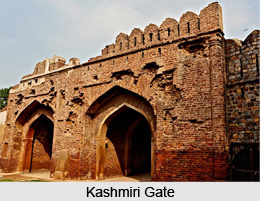
Kashmiri (Cashmere) Gate is situated in the North-Western part of the erstwhile walled city of Shahjahanabad or present-day Old Delhi. The revolt of 1857 provides a significant background to this ‘Darwaza’; it was captured by the rebel sepoys, the double passages of the gate were sealed and its bastion fortified. The British artillery positioned at the Northern Ridge heavily bombarded the Kashmiri Gate. It was in September 1857, after four months of the siege that the gate was finally breached. The gate extensively damaged bears witness to the great Mutiny.
The gateways of Delhi have witnessed significant historical events, both glorious and grisly; numerous stories of love, friendship, and betrayal. It is through these same gateways that I am entering into the heart called Dilli (दिल/ दिल्ली); to witness it in its being, and becoming. Many Dillis that were bustling-rustling in different ages and some that continue to do so. Dilli of those who entered to never depart and those who were never left alone by Dilli. Not chronicling but living: stories of Dilli, by Dilli, from Dilli.

Wednesday, 28 June 2023

All about Traditional Dresses of Gujarat

 The traditional Gujarati dresses for men include kediyu or kurta on the top and dhoti or chorno at the bottom. Women in Gujarat wear sarees or chaniya choli. Recently, they have started wearing salwar kameez as well.

The state of Gujaratis also known as the ‘Jewel of Western India’ and the traditional dress of the state reflects its rich culture and heritage. The traditional dresses of Gujarat are different for both men and women and there is a certain kind of diversity in the costumes. This is because there are various ethnic groups constituting Gujarat’s population.This diversity in dressing represents the age-old culture and the modern changes coexisting in unison with each other.

Traditional Dress of Gujarat for Men
The traditional dress of Gujarat for men mainly comprise of the kediyu or kurta as the upper garment, dhoti or chorno for the lower garments. Discussed elaborately below is the various traditional dress of Gujarat for men:

Chorno: A traditional dress of Gujarat worn only by men, Chorno is a type of cotton pants that looks like a stitched dhoti. Chorno has a string to tie at the waist or have elastic and is loose and comfortable attire for men.

Kediyu: Kediyu is a garment that is worn above the chorno to cover the top part of the body. A kediyu is frock type kurta with frills, worn by the men in Gujarat. Kediyu is also referred to as Angrakhu.

Kurta: A kurta is the top worn to cover the torso of men. The Kurtas for everyday use are made up of cotton. Festive kurtas may have embroideries or some designs in them.

Chaniya: The traditional dress of Gujarati women, the Chaniya is paired with a blouse and an odhni or dupatta. The chaniyo is a kind of lehenga or ghagra with elaborate embroidery and designs on it. Chaniya can be described as a coloured petticoat or skirt-like garment which is designed with heavy mirror and thread work.

Choli: The women wear Polku or Choli on the top. It is an embroidered short blouse. Choli is mainly paired with a chaniya or a ghagra on traditional festivals and occasions. Choli is also worn as a blouse with sarees.


Monday, 26 June 2023

The Prestigious History of Indian Television

 Television in India has been in existence for about four decades. For the first 17 years, it spread haltingly and transmission was usually in black and white. The thinkers and policy makers of the country, which had just been liberated from centuries of colonial rule, though television to be a luxurious element that Indians could do without. In 1955 a Cabinet decision was taken disallowing any foreign investments in print media which has since been followed religiously for nearly 45 years. Sales of TV sets, as reflected by licences issued to buyers were just 676,615 until 1977.The rapid expansion of television hardware in India increased the demand for developing more program software to fill the broadcast hours. Program production, previously a monopoly of Doordarshan, the government-run national television system in India, was then opened to the group of aspiring artists, producers, directors, and technicians. Most of the talented individuals got connected with the television industry.
More and more people set up television cable networks until there was a time in 1995-96 when an estimated 60,000 cable operators existed in the country. Some of them had subscriber bases as low as 50 to as high as in the thousands. Most of the networks could relay just 6 to 14 channels as higher channel relaying capacity demanded heavy investments, which cable operators were unable to make. The multi-system operators (MSOs) started buying up local networks or franchising cable TV feeds to the smaller operators for a typical fee. This phenomenon led to resistance from smaller cable operators who joined forces and started functioning as MSOs. The net outcome was that the number of cable operators in the country fell to 30,000. The rash of players who rushed to set up satellite channels discovered that advertising revenue was not large enough to support them. Gradually, at least half a dozen either folded up or aborted the high-flying plans they had drawn up, and started operating in a restricted manner. Some of them also converted their channels into basic subscription services charging cable operators a specific carriage fee.

The government started taxing cable operators in a proposal to generate revenue. The rates varied in the 26 states that go to form India and ranged from 35 per cent upwards. The authorities moved in to regulate the business and the Cable TV Act, which was passed in 1995. The Supreme Court passed a judgment that the air waves are not the property of the Indian government and any Indian citizen wanting to use them should be permitted to do so.


Thursday, 22 June 2023

Costumes of Tripura

Assam is a beautiful place which happens to be one of the Seven Sisters in the North East. Assam is not just a budding state, but also a place with deep cultural roots and the people here take pride in the refinement of their cultural roots. This state portrays its beauty not only in its serenity and lush green forests but also in the way the people dress traditionally. Tradition is the caravan of the heritage passed on to us by our forefathers, and these people here have very elegantly managed to carry forward the flame that was passed to them rightly. Here, let's have a look at the beautiful and exquisite pieces of clothing that one can find only in Assam.

 The traditional dresses of Assam consist of the Muga or the golden silk fibre which has a huge demand in the global market. Besides the 'Muga' variety there is the 'Eri' and the 'Paat' that are being used mostly in the making of traditional clothes in Assam. The former is used to make winter garments especially shawls called 'Eri Chadar' and the latter is used for the making of 'Mekhela Chadar.'
The 'Muga' is the most important and the most preferred wild silk all over India and is the main cause behind the exquisiteness and elegance of the Assam Silk saris. The delicate designs, finely woven on the saris cater to patterns in nature, for example, the flora and fauna. Embroideries also incorporate, acquainted and culture-related things, such as architecture and stone sculptures on the Madan Kamdev Temple in Assam.

The Dhoti and Gamosa are said to be the native dress of the men of Assam. The Dhoti is used to cover the lower half of the body and is a well-known piece of clothing in other Indian traditions too. Wearing a Dhoti properly is not so easy and carrying it is also one tricky job. The Gamosa is a rectangular piece of cloth that is an important and significant part of the Assam culture. Gamosa means 'A cloth to wipe one's body' and is a white cloth with a beautiful red border on three sides and woven motifs on the remaining one. It is a piece of clothing that has some great significance in this state hence it is also used to felicitate and honour people who achieve some great feat. The Gamosa can be used as a cloth to wipe or can be transformed into a waistcoat which is commonly


known as the Tongali. It can also be used as a Loincloth by a Bihu dancer. 

Tongali is a form of gamosa worn in a different way. People who wear Gamosa take the cloth in two ways. Either they wear it as it is, or create a waistcoat of it which is known as Tongali. Nowadays, people have created a number of options in terms of style and material.

Other Famous Costumes are :

Costumes of Nagaland

Costumes of West Bengal

Costumes of Haryana


Tuesday, 20 June 2023

Exploring Eastern Districts of Haryana

Districts of East Haryana are dotted with the history of Mahabharata Era and the later history of India. These districts are Sonipat district, Panipat district, Kurukshetra district, Karnal District and Jhajjar District.

Sonipat District
Sonipat district is one of the 21 districts of Haryana. Sonipat town is the district headquarters. It is a part of National Capital Region along with Delhi, Gurgaon, Faridabad, Noida, Ghaziabad. Sonipat district borders Delhi in south, Panipat District in the north, Jind District in the north-west, Uttar Pradesh state in the east with the Yamuna River acting as a border and Rohtak District in the west.

Panipat District
Panipat district is blessed with the historical town of Panipat, which is the administrative headquarters of the district. The district occupies an area of 1268 square km, making it the 19th largest in the state with Gurgaon and Panchkula following it. This area is known in Indian history for the battles during Delhi Sultanate era and the Mughal Era.

Kurukshetra District
Kurukshetra district is headed by the town of Kurukshetra. It is a sacred place for the Hindus. It is the administrative headquarters of this district. The district occupies an area of 1682.53 km ². The district has a population of 825,454. This district is part of Ambala division.

Karnal District
Karnal district has the Karnal town which is the administrative headquarters of the district. 

Jhajjar district is carved out of Rohtak district on 15th July 1997 and with its headquarters in Jhajjar. It lies 29 kilometres (18 mi) from Delhi and had developed into an important industrial center. Other towns in the district are Bahadurgarh and Beri. Jhajjar district occupies an area of 1,834 square kilometers and as of 2001 its population was 709,000. It has two industrial areas with 2408 plots. The basic industries in Jhajjar District are ceramics, glass, chemicals, engineering, electrical and electronics. There are 48 large and medium units along with 213 small-scale units. The major crops grown in Jhajjar District are rice, wheat and maize. The total irrigated agricultural land area is about 670 square kilometers.

Thursday, 15 June 2023

Indian Goddesses


Goddesses of India are huge in number and are worshipped in all parts of India among the Hindu people. Goddess in India is the female deities who have gained prominence and are widely worshipped with great splendour and piety. The Hindu Goddesses have got place in the ancient Hindu scriptures like Bhagavad GitaRamayana and Rig Veda. Some of the noted Goddesses of India are discussed below:

Goddess Durga
Goddess Durga is a form of Devi, the supreme goddess, having ten arms and each arm has a separate weapon and seated on a lion or a tiger. Durga is the manifestation of the power that helps in preserving the moral order and virtue in the creation. She is like the mother who protects her child or mankind, by destroying the evil forces of selfishness, anger, ego and creating a peaceful environment for her child to live in. She is also known as Parvati, Ambika and Kali. She saved the Devas from the hands of Mahishasura, the Demon. Durga is also known as ‘Ambey Mata’ in the northern parts of IndiaNavratri is celebrated all over the country celebrating her valour and prowess that helped Lord Rama to release his bride from his captivity.

Goddess Kali
Another important Goddess of Hindus is the Goddess Kali who is the divine mother seen in a more violent form. She sent her ‘Shakti’ to bestow peace to the Gods after freeing them from demons called Shumbha and Nishumbha. Kali is the first of the Ten Mahavidyas, acquiring the name ‘Adya’ - the goddess, or the first born. Kali is also the Kundalini energy that frees one from the fear of death.

Goddess Saraswati
Goddess Saraswati is the goddess of knowledge, music and all other creative forms. She is the goddess of speech, repository of Lord Brahma’s creative intelligence and Mother of the Vedas. Saraswati’s ‘vahana’ is the Swan, which is noted for its extraordinary capabilities for separating water out of milk, symbolizing the power to differentiate between the good and the bad.
Click below to learn more
https://www.indianetzone.com/5/goddesses_india.htm

More articles:-

Monday, 5 June 2023

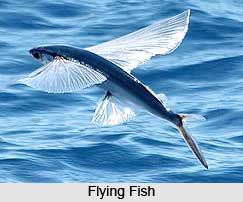
Discovering unique features of Flying Fish


Flying fish predators include mackerel, tuna, swordfish, and marlin all of which are large fast fish. To escape them, flying fish gather speed and leap from the ocean, gliding into the air so they can’t be grabbed from behind.Unfortunately, once in the air, they are prey to birds. Poor flying fish just can’t win. They feed a lot of other creatures and are an essential part of the ecosystem as a result.
Flying Fish is mostly found in the south western Indian seas. This fish can fly a maximum distance of about four hundred metres over the surface of sea water.Their flying ability most likely evolved so they could escape predators. 

Flying Fish

Flying Fish is a type of fish which during its normal swimming movement in water can occasionally take to aerial flight by jumping into the air and gliding horizontally. The distance thus covered is at times as long as four hundred metres. These fishes occur on both east and west coasts of India, but more on the south-west where they form a fishery in winter months. They belong to the family Exocoetidae. The species are recorded from Indian seas, of which three, Cypselurus altipennis, Exocoetus volitans, and Paraexocoetus brachypterus are common.

There are small twenty five centimetres long fish with elongated roundish body and long broad pectoral fins extending up to the tail fin, the lower lobe of which also is elongated and pronounced. In some species the pelvic fin too is enlarged. Being pelagic, they swim usually in the upper strata of water. When they are about to fly, they accelerate their speed for a short distance, then suddenly jerk their head out of water and with powerful vibrations of the caudal portion of their body and the tail fin kick the water surface and become air-borne like a plane, spreading out their large pectoral fins for gliding. The pectoral fins are not flapped like birds' or butterflies' wings but kept distended.

Flying fish are attracted to light as many ocean animals are. For thousands of years, fishermen have used light as a lure. A canoe filled with water with a luring light attached is enough to make plenty of flying fish leap into the canoe. Once they’re in, they can’t get enough speed to leap out.Flying fish are a delicacy in up-market restaurants so they are always in demand.


Saturday, 3 June 2023

Indian Long Jumpers- Pride of India

Indian long jumpers, almost in all cases, come from a very humble and modest background. The sport in itself is less popular in India, hence not lot of attention is received from the masses, media or government sports authorities.

 Indian long jumpers, almost in all cases, come from a very humble and modest background. The sport in itself is less popular in India, hence not lot of attention is received from the masses, media or government sports authorities.

Vijay Singh Chauhan
Vijay Singh Chauhan is a former Indian athlete who won gold medal in decathlon in 1974 Asian Games. He participated in 1972 Olympics. He was born in 1949 in Uttar Pradesh state. He was honoured with Arjuna award.


Reeth Abraham
Reeth Abraham is an athlete from India and was once the national champion in long jump and heptathlon. She won the Arjuna Award in 1997.

Mayookha Johny
Mayookha Johny, born 9 April 1988, is an Indian track and field athlete from Kerala who specialises in long jump and triple jump. She holds the current Indian National record for triple jump with a mark of 14.11m. She is the first Indian woman to cross the 14m mark.

Kumaravel Premkumar
Kumaravel Premkumar is an Indian long jumper from Tamil Nadu. He is the national record-holder in both indoor and outdoor long jump. He won a bronze medal at the 2012 Asian Indoor Athletics Championships and a silver at the 2013 Asian Athletics Championships.

Sammudi Balasubramaniam
Sammudi Balasubramaniam was an athlete hailing from Tamil Nadu who specializes in long jump and triple jump. He was the second Indian to secure a bronze medal in triple jump in Asian Games.

Tuesday, 30 May 2023

South Indian States-Unity in Diversity


South Indian states formed a linguistic unity in independent India and preserved the traditional culture and artwork despite of having many foreign invasions before its independence in modern age. South Indian states form the peninsular part of India, also known as Dakshin Bharat.


South Indian states include TelanganaAndhra PradeshTamil NaduKarnataka and Kerala. These South Indian states are covering the southern part of the peninsular Deccan Plateau. These states are bounded by the Bay of Bengal in the east, the Arabian Sea in the west and the Indian Ocean in the south. The geography of the region is diverse with two mountain ranges - the Western Ghats Mountain Range in India and Eastern Ghats Mountain Range in India, bordering the plateau heartland. Godavari RiverKrishna RiverKaveri RiverTungabhadra River and Vaigai River are important sources of water. BengaluruChennaiHyderabadAmaravatiCoimbatore and Kochi are the largest urban areas in the south Indian states with the scope to develop the economic sectors.

Geography of South Indian States
The peninsular India shaped like an inverted triangle is guarded by sea on all sides. It has Vindhyas and Satpura ranges running along the coastal regions while Eastern Ghats and Western Ghats meeting at the Nilgiri mountains. The low-lying coral islands of Lakshwadeep form the southwestern coast of India while the Andaman and Nicobar islands are located in the eastern coast. The Palk Strait and the chain of islands forming Rama's Bridge separate southern India from Sri Lanka. The southernmost tip of India is at Kanyakumari which is also the meeting point of the Indian OceanBay of Bengal, and the Arabian Sea. The Deccan plateau is also an elevated region bounded by mountains and watered by many rivers and their tributaries.


Climate of South Indian States


Southern India has tropical climate and mostly depends on monsoon for rainfall. Some of the regions are considered warmest in the country with average daily high temperature of 33 degrees C. It is warm to hot all year round, at average water temperatures of 28 degrees C. Precipitation is comparatively less here and wintersummer, and monsoons are the main seasons.


Diversity of languages of Andhra Pradesh

 Languages of Andhra Pradesh belong to the Dravidian language group. Telugu is the official language in Andhra Pradesh including Telengana region. In October 1953, the state was constituted and Telugu was acknowledged with this status. India comprises of different linguistic communities, each sharing a common language of their own. The Indian languages belong to four classes of languages: Mon-Khmer, Sino-Tibetan, Indo-European and Dravidian. These languages are grouped on the basis of geographical locations in India.

The main languages that are spoken by people of Andhra Pradesh are Telugu, Hindi, Banjara, Urdu and English.

Telugu Language: Telugu is one of the 23 official languages of India. The subtlety of the language emphasizes the language's profundity. Telugu is an exceptionally robust language and is highly moulded by Sanskrit influence. It was also referred to as ‘Tenugu’ in the past. Amongst the Dravidian languages, Telugu is mostly spoken by the people. In terms of population, Telugu ranks second to Hindi among the Indian languages. The Telugu alphabet is called ‘Onamaalu’.

Kannada Language: Since, Telugu has a close resemblance with Tamil, Kannada and Tulu, Kannada is also one of the spoken languages in Andhra Pradesh. Though Kannada is the official language of Karnataka, it has some significant linguistic minorities in Andhra Pradesh. Kannada is considered to be one of the oldest living languages.


Monday, 29 May 2023

Jhoti Chita- Traditional art of Odisha

 Jhoti Chita is a traditional art of Odisha, which is done with rice paste on walls and floors during puja or ocassions. It is mainly drawn using fingers as well as brush and represents different patterns of religious or spiritual significance.

Jhoti Chita, also known as Rangoli, is a traditional art or painting of Odisha which is mostly found in the rural parts of the state. Jhoti Chita or Rangoli is created by making beautiful patterns on the walls or floors using an improvised brush made of cotton and stick or piece of cloth. It can also be done with bare fingers.
Painting technique of Jhoti Chita
While Rangolis are made using coloured powders, Jhoti involves line art using the traditional white coloured, semi liquid paste of rice or Pithau. The watery or semi-liquid rice paste is soaked in a piece of cloth or small cotton ball for the drawing. This cloth or cotton ball is usually surrounded with a stick or twig for better grip. The painting mainly portrays different patterns and shapes. Some of them represent religious signs or symbols while others can be just patterns for beautification.

Colours of Jhoti Chita
Several figures and flower patterns are drawn in Jhoti Chita or Rangoli. Before starting the painting, an earthy red colour named ‘dhau’ is smeared on the walls and floors and then the Jhotis are created. It provides a contrasted colour. Dhau is also used as a background colour of Jhoti drawings.


Religious significance of Jhoti Chita
Jhoti Chita is made during certain festivals like marriage, Manabasa Gurubara, Basanti, KaartikaDolaJhulana
, Dhanalak
shmi puja, Gaja Lakshmi puja and Raja. For different festivals, different types of motifs are drawn on the walls or floors. For example, during Lakshmi puja, a stack of paddy or rice sheaves is drawn on the walls structured like a pyramid as it symbolizes goddess Lakshmi. Small foot marks of goddess Lakshmi are a must in any Jhoti. During Durga Puja, white and red dots are painted on the walls. This combination of red and white signifies the worship of Shiva and Shakti. Intricate and beautiful floral designs like the lotuselephants, symbols used in Patachitra find place in this form of free hand drawing.

Bay of Bengal

 Bay of Bengal is a triangular shaped bay in the Indian Ocean, and has derived its name from West Bengal, which lies on the north.

 Bay of Bengal lies in the north eastern part of the Indian Ocean. It is in fact a triangular shaped salt-water sea. The bay is surrounded by the Malay Peninsula on the east, and by the Indian subcontinent on the west. The northern section of the bay borders the Bengal region, comprising the Indian state of West Bengal and the country of Bangladesh. As it surrounds the Bengal region, the bay has derived the name Bay of Bengal. The southern tips margin the island country of Sri Lanka, and the Indian Union Territory of the Andaman and Nicobar Islands. Many large rivers including GodavariKrishnaKaveriGanga and Brahmaputra flow into it.Climate of Bay of Bengal
The monsoon currents regulate the climate of the Bay of Bengal and the regions around it. During the months of January to October, the current flows towards the north in a clockwise circulation pattern and is called the East Indian Current. The Bay of Bengal monsoon moves in a northwest direction hitting the Andaman and Nicobar Islands at the end of May and then the North Eastern Coast of India by the end of June. Throughout the remaining part of the year, a counter-clockwise current flows towards the southwest direction, and is called the East Indian Winter Jet. During the months of September and December the weather is very active. The monsoon season often brings in severe cyclones, which affect Eastern India as well as parts of other countries. The 1971 Orissa cyclone is one of the worst.Bay of Bengal, Indian Physiography