Showing posts with label indian monuments. Show all posts

Friday, 6 September 2024

Monuments of North India: A Tour Through History and Culture


North India is renowned for its rich historical and cultural heritage, which is beautifully encapsulated in its diverse array of monuments. The Monuments of North India stand as a testament to the country’s rich history. From grand forts to exquisite temples, these structures offer a glimpse into the region's storied past.

1. Red Fort, Delhi

One of the most iconic monuments of North India is the Red Fort in Delhi. Constructed by the Mughal Emperor Shah Jahan in 1648, this massive fortification is renowned for its stunning red sandstone walls and intricate Mughal architecture. The fort's historical significance is underscored by its role as the main residence of Mughal emperors for over 200 years and its place in India's struggle for independence.

2. Taj Mahal, Agra

The Taj Mahal in Agra is a global symbol of love and an architectural masterpiece. Built by Emperor Shah Jahan in memory of his wife Mumtaz Mahal, this white marble mausoleum is celebrated for its stunning symmetry and elaborate inlay work. As a UNESCO World Heritage site, the Taj Mahal attracts millions of visitors annually and is often regarded as one of the New Seven Wonders of the World.

3. Qutub Minar, Delhi

Another remarkable monument in Delhi is the Qutub Minar. Erected in 1193 by Qutb-ud-din Aibak, this towering minaret stands at 73 meters and is the tallest brick minaret in the world. It is an important example of early Indo-Islamic architecture and is surrounded by ruins of ancient structures that add to its historical context.

4. Fatehpur Sikri, Uttar Pradesh

Fatehpur Sikri, built by Emperor Akbar in the late 16th century, is a city constructed entirely of red sandstone. It served as the Mughal Empire’s capital for a brief period before being abandoned. The complex includes stunning buildings like the Diwan-i-Khas (Hall of Private Audience) and the Buland Darwaza (Victorious Gate), showcasing Akbar’s architectural vision and administrative innovations.

5. Golden Temple, Amritsar

The Golden Temple, or Harmandir Sahib, in Amritsar is a sacred Sikh shrine and an architectural marvel. Built in the 16th century, its golden facade and tranquil surroundings reflect the spiritual and cultural ethos of Sikhism. The temple's community kitchen, serving free meals to thousands daily, embodies the Sikh principle of selfless service.

6. Humayun’s Tomb, Delhi

Humayun's Tomb, completed in 1572, is an early example of Mughal architecture and a precursor to the Taj Mahal. The tomb, built for Emperor Humayun, is set within a beautiful garden and is notable for its use of red sandstone and white marble.

These monuments of North India not only highlight the region's historical grandeur but also its diverse cultural influences. Each site offers a unique window into the past, reflecting the artistic, architectural, and cultural achievements of different eras.


Friday, 2 August 2024

Monasteries in Himachal Pradesh: A Glimpse into Spiritual Heritage


Himachal Pradesh, nestled in the northern Himalayas, is renowned not only for its breathtaking landscapes but also for its rich cultural and spiritual heritage. Himachal Pradesh is the cradle of Tibetan Buddhism in India and the monasteries of the state are the standing embodiments of the same. Among the most intriguing aspects of this region are its monasteries, which serve as tranquil sanctuaries of Buddhist practice and learning.


Key Monasteries in Himachal Pradesh


1. Key Monastery: Situated at an altitude of 4,166 meters in the Spiti Valley, Key Monastery is one of the most prominent and oldest monasteries in Himachal Pradesh. Established in the 11th century, it is a center for the Gelugpa sect of Tibetan Buddhism. The monastery's fortress-like structure and its striking location against a backdrop of stark, snow-capped mountains make it a must-visit for spiritual seekers and tourists alike.


2. Tabo Monastery: Often referred to as the "Ajanta of the Himalayas," Tabo Monastery is located in the Spiti Valley and is renowned for its ancient murals and sculptures. Founded in 996 AD by the Tibetan king Yeshe Od, it is one of the oldest and most significant Buddhist monasteries in the region. Its intricate art and historical significance attract scholars and devotees from around the world.


3. Dhankar Monastery: Perched at an elevation of 3,894 meters, Dhankar Monastery overlooks the confluence of the Spiti and Pin Rivers. Founded in the 12th century, it is renowned for its stunning location and its impressive collection of Buddhist manuscripts and thangkas (traditional Tibetan paintings).


4. Mcleod Ganj Monastery: Known as the residence of the Dalai Lama, Mcleod Ganj is a vibrant center of Tibetan culture and Buddhism. The Namgyal Monastery, located here, plays a crucial role in preserving Tibetan Buddhist traditions and practices. Visitors can engage in meditation sessions, attend teachings, and explore Tibetan culture in this lively monastic community.


Cultural and Spiritual Significance


These monasteries are not only places of worship but also serve as repositories of Buddhist art, literature, and philosophy. They are vital centers for preserving Tibetan culture and traditions, offering visitors a glimpse into the spiritual and artistic heritage of the region. The serene environment of these monasteries provides a perfect setting for meditation and reflection, making them essential destinations for those seeking both spiritual enlightenment and cultural enrichment in Himachal Pradesh.


Thursday, 27 June 2024

Journey Through Buddhist Monasteries in India


Buddhist monasteries in India are not just architectural marvels but also repositories of profound history and diverse methodologies in spiritual practice. Buddhist Monasteries are considered to be one of the most holy and sacred places in the country. Every year, millions of people from all corners of the world throng to these monasteries in search of eternal peace.


The history of Buddhist monasteries in India is intricately tied to the life and teachings of the Buddha himself. Following his enlightenment in Bodh Gaya, Buddha established the first monastic community at Sarnath, where he delivered his initial sermon on the Four Noble Truths. This event marked the beginning of the Sangha, the community of Buddhist monks and nuns, and laid the foundation for monasticism in Buddhism.


Methodologically, Buddhist monasteries serve as centers for meditation, study, and communal living according to the Vinaya, the code of conduct for monks and nuns. Monastic life emphasizes simplicity, ethical conduct, and the pursuit of wisdom through study and contemplation. Monks typically engage in daily rituals, chanting, and meditation practices aimed at cultivating mindfulness and insight.


In terms of types, Buddhist monasteries in India vary widely. Some, like those at Bodh Gaya and Sarnath, are historical and pilgrimage centers, drawing thousands of devotees annually. Others, such as those in Ladakh and Himachal Pradesh, are nestled in the Himalayan foothills, blending traditional Tibetan Buddhist architecture with local influences. These monasteries often serve as educational institutions for monks and lay practitioners alike, offering teachings on Buddhist philosophy, meditation techniques, and ritual practices.


Throughout history, Indian Buddhist monasteries have also played significant roles in the preservation and transmission of Buddhist scriptures and teachings. Monastic libraries and scriptoriums were pivotal in transcribing ancient texts onto palm leaves and later manuscripts, ensuring the continuity of Buddhist philosophy and practice across generations.


In conclusion, Buddhist monasteries in India stand as living embodiments of Buddhist principles and traditions, embodying rich histories, diverse methodologies in spiritual practice, and serving as vital centers of learning and meditation. Their enduring presence continues to inspire and attract seekers of wisdom and spiritual enlightenment from around the world.

Friday, 20 October 2023

Chavand Fort

 Chavand Fort is situated on the top of a hill in Junnar taluka in the district of Pune in Maharashtra state. It is located in the Sahyadris mountain Range and is almost 30 km from the present Naryangoan town in Junnar taluka. The fortification was built at an elevation of 3400 feet (1036 m) above sea level. The Chavandwadi village is located at the base of the hill fort.


From the western side of the Chavand Fort, there is a way to go to the top of the fort along with the school of the village. The time required to reach the entrance of the door is about 45 minutes from the western side of the Chavand Fort. From here stairs will take us to the plains of the fort on which remnants of many constructions can be seen.

The base village of the fort is called Chavandwadi and any bus/vehicle going towards Aptale can drop you at Chavandwadi. Once you start the trek from Chavandwadi, you reach rock steps which were destroyed by the British Army. After a short while you will see a huge stone door built in the Gomukhi style architecture. This door is called the Mahadarwaja. From the Mahadarwaja the route splits into two, the left one takes you to the fort walls and the right one takes you to the top of the fort.

On the top of the fort the path further splits into two, the left one takes you to a dilapidated temple and the Seven tanks, while the right one takes you to the Chamunda devi temple.

Monday, 9 October 2023

Belapur Fort

 Belapur Fort is an ancient hill fort that is located in Belapur Township in Navi Mumbai in the state of Maharashtra. The structure has an elevation of almost 89 ft (27 m). It was built in 1560 by the Siddis of Janjira. Later it was occupied by the Portuguese and then by the army of Maratha Empire. Eventually the structure was conquered by the British East India Company during the early 19th century. The strategic significance of Belapur Fort reduced to a great extent after the East India Company achieved political supremacy in the region and also after the development of the Bombay Presidency.


History of Belapur Fort

The construction of Belapur Fort began in the year 1560 and ended in 1570. It was built by the Siddis of Janjira after they seized control of the region from the Portuguese. It is located near the mouth of the Panvel Creek. Later the Portuguese forces again occupied the fort in 1682. However in 1733, the forces of the Maratha Empire, under the leadership of Chimnaji Appa, took over the fort and the region by defeating the Portuguese. He had made a vow that if it was successfully recaptured from the Portuguese, he would place a garland of beli leaves in the Amruthaishwar temple. After the victory the fort was christened as Belapur Fort. The Maratha Empire reigned over the region of Belapur till June 1817. Afterwards, the territory and the fort were occupied by the army of the British East India Company, under the command of Captain Charles Gray. The British forces dismantled and demolished the structure to some extent because of their military policy of destroying any Maratha stronghold. The British partially destroyed the fort. A tunnel is also supposed to exist, which according to locals, connects it to Gharapuri Island, the site of the Elephanta Caves

Kavaledurga Fort

Initially built in the 9th century, the Kavaledurga Fort is a historical monument that is located about 18 km from Thirthahalli in the Shimoga district of the state of Karnataka.


History of Kavaledurga Fort
Renovated in the 14th century by Cheluvarangappa, the Kavaledurga Fort was then called Bhuvanagiri, which was a stronghold of the Nayakas of Keladi. They had a feud with the Vijayanagara rulers but soon gained independence after their fall. Venkatappa Nayaka fortified the place and built a palace. The Kavaledurga Fort has three lines of walls, which are constructed of huge granite blocks following the natural contour of the hillock. Each fortification has a gateway flanked by guard rooms on either side and in between these fortifications, there are temples, a ruined palace site and basement of structures.


Kavaledurga Fort an abode of Gods

There were around fifteen temples within the fortifications, but only three of the temples still exist – Kashi Vishwanatha temple, Sri Lakshmi Narayana temple and Shikareshwara temple. The Lakshmi Narayana temple is situated on a rock with natural steps leading up to it.The Shikareshwara temple is situated almost at the centre of the fort, on a natural hillock and affords a panoramic view of the area. The Kashi Vishwanatha temple is unique for its Islamic style doorway and the presence of two stone pillars at the entrance.

Friday, 6 October 2023

Sudhagad Fort


Sudhagad Fort is an ancient Indian hill fort which is located in the district of Raigad in Maharashtra state, India. The geographical coordinates of the site is latitude 18.54°N 73.32°E. It is situated almost 26 km towards the south of Lonavla, 53 km towards the west of Pune and 11 km to the east of Pali in Raigad district. The fortress is also known as Bhorapgad Fort. It is built at an elevation of 620 m above sea level.


History of Sudhagad Fort
Sudhagad Fort is believed to be built in the 2nd century B.C. It was initially known as Bhrorapgad and was named after the Goddess Bhoraidevi. The rulers of the Bahamani Sultanate captured the fortification in 1436. It was eventually conquered by the army of the Martha Empire in 1657. During this period, the fort was renamed as Sudhagad. Chatrapati Shivaji Maharaj, the founder of the Maratha Empire, considered Sudhagad Fort as one of the most significant forts of his kingdom as it was spread over a large area. The Pantsachivas of Bhor were appointed as the keepers of this fort during the reign of the Peshwas.

Thursday, 29 June 2023

Gates of Delhi

 Gates of Delhi were built by different rulers belonging to different dynasties. Ajmeri Gate, Turqman Gate, Delhi Gate, Nigambodh Gate, Bahadur Shahi Gate, Khooni Darwaza, are some of the famous gates here.

Gates in the First City
In the first city of Delhi, 13 gates were built in the 11th century citadel of Lal Kot. However, only a few of them remain now. These are the Chaumukha, Sohan, Ranjit, Fateh, Hauz Rani, Barka, Badaun and Budayuni gates. Among these the Chaumukha, Ranjit, Sohan and Fateh darwazas are regarded as heritage monuments by the INTACH.
The Chaumukha Darwaza, is the gate way of Lal Kot. It is located close to the Qutub Complex and is conserved by the Archaeological Survey of India. That architectural style of the gate belongs to the Tuglaq period. The Ranjit gate located towards the north wall of Lal Kot is in ruined state now. It is through this gate that the Turks had entered the city. Presently only part of the gate can be seen. The Fateh Gate has been made in a complicated way and is about 24 m in diameter. The Sohan Gate here is guarded by a large bastion. Hauz Rani and Budayuni Gates, which were once prominent gates, are now in ruins. The Budayuni gate was earlier the chief gate of the city by Ibn Battuta. It is here that Ala-ud-din Khilji broke all his wine caskets and shunned drinking. The guilty were also punished here. Ala-ud-din Khilji wanted to build four darwazas (gates). He could however build only one, the Alai Darwaza. It has a wide and bulging dome and is built of red sandstone.
Gates of Second City
The second medieval city comprises of the Siri Fort. It was built during the reign of Ala-ud-Din Khalji of the Delhi Sultanate. It was built to protect the city from the terror of the Mongols. When the city was built it was adorned with palaces and other rich structures. It then had seven gates for entry and exit. However, only the South eastern gate exists presently. Rest all were destroyed by the local rulers of subsequent dynasties to establish their own buildings and palaces.


Gates of Third City
The third city, Tughlaqabad of the medieval Delhi was erected by Ghazi Malik well known as Ghiyath al-Din Tughluq. He is known for establishing the Tughluq Dynasty in 1321. The city was enclosed within a massive fort that was built within four years. When the city was built it is said to have 52 gates but only 13 remain today. Rest all the other gates are in ruins now. The architectural design of the main entry gate to the fort resembles the Patthan style. It had been made of red sand stone with sloping face and jambs.
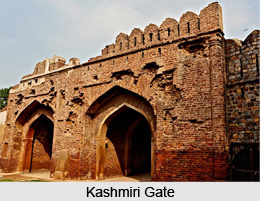
Kashmiri (Cashmere) Gate is situated in the North-Western part of the erstwhile walled city of Shahjahanabad or present-day Old Delhi. The revolt of 1857 provides a significant background to this ‘Darwaza’; it was captured by the rebel sepoys, the double passages of the gate were sealed and its bastion fortified. The British artillery positioned at the Northern Ridge heavily bombarded the Kashmiri Gate. It was in September 1857, after four months of the siege that the gate was finally breached. The gate extensively damaged bears witness to the great Mutiny.
The gateways of Delhi have witnessed significant historical events, both glorious and grisly; numerous stories of love, friendship, and betrayal. It is through these same gateways that I am entering into the heart called Dilli (दिल/ दिल्ली); to witness it in its being, and becoming. Many Dillis that were bustling-rustling in different ages and some that continue to do so. Dilli of those who entered to never depart and those who were never left alone by Dilli. Not chronicling but living: stories of Dilli, by Dilli, from Dilli.