Showing posts with label indian religion. Show all posts

Saturday, 20 January 2024

Caste laws in Manu Smriti


 The caste Laws in Manu Smriti claims a divine origin and codifies some of the laws of the Hindu caste system. The rigidity in the caste system is one of the main features of the caste laws. The divine order of caste as prescribed:

1. The Brahmin came from the mouth of Lord Brahma.
2. Kshatriya issued from the arms of Brahma.
3. The 
Vaishya comes from the thighs.
4. The Shudra comes from Brahma's feet.

Over fifty manuscripts of the Manusmriti are now known, but the earliest discovered, most translated and presumed authentic version since the 18th century has been the "Kolkata (formerly Calcutta) manuscript with Kulluka Bhatta commentary".Modern scholarship states this presumed authenticity is false, and the various manuscripts of Manusmriti discovered in India are inconsistent with each other, and within themselves, raising concerns of its authenticity, insertions and interpolations made into the text in later times.


The metrical text is in Sanskrit, is dated to the 1st to 3rd century CE, and presents itself as a discourse given by Manu (Svayambhuva) and Bhrigu on dharma topics such as duties, rights, laws, conduct, virtues and others. The text's influence had historically spread outside India. The text influenced Hindu kingdoms in Cambodia and Indonesia.

The structure and contents of the Manusmriti suggest it to be a document predominantly targeted at the Brahmins (priestly class) and the Kshatriyas (king, administration and warrior class).The text dedicates 1,034 verses, the largest portion, on laws for and expected virtues of Brahmins, and 971 verses for Kshatriyas.The statement of rules for the Vaishyas (merchant class) and the Shudras (artisans and working class) in the text is extraordinarily brief. Olivelle suggests that this may be because the text was composed to address the balance "between the political power and the priestly interests", and because of the rise in foreign invasions of India in the period it was composed.


Monday, 27 November 2023

Vishwakarma Caste

  Vishwakarma Caste describes a Brahmin Caste of India who claims to be descendants of Lord Vishwakarma. They are a caste of priests, engineers, architects, sculptors, temple builders and artists. The term is applied to five sub-castes; blacksmiths, carpenters, coppersmiths, goldsmiths and sculptors. Vishwakarma Caste is also known as Vishwabrahmin or Dhiman Brahmins or Jangid Brahmins. The Vishwakarma Caste also claim to have been the spiritual guides and priests and their position in the society survives in the saying the Vishwabrahmana is guru to the world.


The community claims to be descended from the god Vishvakarma, who is considered by Hindus to be the divine architect or engineer of the universe. He had five children — Manu, Maya, Tvastar, Shilpi and Visvajna — and these are believed by the Vishwakarma community to have been the forebears of their five subgroups, being respectively the gotras (clans) of blacksmiths, carpenters, bell metalworkers (metal casters), stonemasons and goldsmiths. It is not known whether these five subgroups historically practised endogamy, which is a frequently-found feature of the Indian caste system.

The origin myths of the Vishwakarma community were first consolidated in the early 18th century, during the British colonial rule. These myths were compiled in the Vishwakarma Puranam, whose original manuscript is undated but was most probably created in the mid-17th or 18th century.According to a popular myth recorded in the Vishwakarma Puranam, the five children of the god Vishwakarma served the gods as artisans, and possessed the ability to create things by simply visualising them. They had conserved their veerya by being celibates, and lived in a fort on the coast of Ilangapuri (Sri Lanka).The fort was made of lodestone, and the enemy weapons thrown at it were stuck to its walls, rendering it invincible. Their chief enemy was Karunakaran, a vassal of the Chola emperor. In order to defeat the Vishwakarmas, Karunakaran planted many beautiful women (Brahmin women according to some versions of the legend) in the fort. These women married the Vishwakarmas, thus destroying their spiritual power, and learned the secret that a certain type of poisonous grass could be used to burn up the fort. Using this secret, the enemy blew up the fort, and the Vishwakarmas were scattered in various areas, where they were forced to work as artisans and craftsmen for mortal humans.


Friday, 24 November 2023

Brahmin Caste


 Brahmin is considered as a member of the priestly caste of the country. In Hinduism, there is the concept of ‘Varna’ system where the society is stratified into four ‘Varnas’ or castes - Brahmin, Kshatriya, Vaishya, Sudras. The Brahmin occupies the highest level in the ‘Varna’ system and is considered to be the priest class in the Varna system of ancient India. The word ‘Brahmin’ has been derived from the Sanskrit word ‘Brahmana’. Besides Hinduism, Brahmins are also found in Buddhism. Dhammapada has a list on the Buddhist Brahmin section. Brahmin Bhikshus were quite common with this religious sect. Other sects like Jainism, Islam and Sikhism also bear testimony to the existence of Brahmins within their religious sects.

Brahman, highest ranking of the four varnas, or social classes, in Hindu India. The elevated position of the Brahmans goes back to the late Vedic period, when the Indo-European-speaking settlers in northern India were already divided into Brahmans (or priests), warriors (of the Kshatriya class), traders (of the Vaishya class), and labourers (of the Shudra class). Since then there has been no fundamental change in their relative position, and the Brahmans still enjoy great prestige and many advantages, though their claim to tangible privileges is no longer officially admitted. The basis of the age-old veneration of Brahmans is the belief that they are inherently of greater ritual purity than members of other castes and that they alone are capable of performing certain vital religious tasks. The study and recitation of the sacred scriptures was traditionally reserved for this spiritual elite, and for centuries all Indian scholarship was in their hands.
The ritual purity of the Brahmans is maintained through the observance of numerous taboos, many of which relate to diet and contact with lower castes. Most Brahman castes are strictly vegetarian, and their members must abstain from certain occupations. They may not plow or handle any impure material, such as leather or hides, but they may farm and do such agricultural work as does not violate these specific restrictions. They may also accept employment as domestic servants; many well-to-do Hindus have Brahman cooks, who are valued because members of all castes may eat the food that they prepare.

Friday, 8 September 2023

Ved Vyas- Sanatan Dharma’s first and greatest Acharya

Ved Vyas was the first and greatest Acharya of Sanatan Dharma and the author of the great epic Mahabharata. He is responsible for classifying the 4 Vedas, wrote 18 Puranas and recited the great Mahabharata. In fact, the Mahabharata is often called as the 5th Veda. The most important and the most glorified section is the "Bhagwad Gita", the lesson recited to Arjuna by Lord Krishna on the battlefield. Apart from the Mahabharata, he also wrote the "Brahma Sutra", one of his shortest theologies on Hindu philosophy. It is said that Ved Vyas is immortal and he never died. The life of Ved Vyas is an example to all in the modern times on how to be selfless and devote oneself entirely to Lord in order to attain Nirvana.


Personal Life of Ved Vyas
Ved Vyas is also known as ‘Krishna Dvaipayana’. Around some 5000 years ago, he was born on an island in the holy river Yamuna in Damauli of Tanahi district, which is presently in Nepal. His father was Rishi Parashar, a sage and his mother was Satyavati. He taught the Vedas to his pupils with ardent devotion and dedication. It is said that Mahabharata is the 18th Puran that was written by Ved Vyas. He fathered four famous sons, Pandu, Dhritarashtra, Vidur and Sukhdev. Ved Vyas received knowledge from great sages like Vasudeva and Sanakadik.

Thursday, 15 June 2023

Indian Goddesses


Goddesses of India are huge in number and are worshipped in all parts of India among the Hindu people. Goddess in India is the female deities who have gained prominence and are widely worshipped with great splendour and piety. The Hindu Goddesses have got place in the ancient Hindu scriptures like Bhagavad Gita, Ramayana and Rig Veda. Some of the noted Goddesses of India are discussed below:

Goddess Durga
Goddess Durga is a form of Devi, the supreme goddess, having ten arms and each arm has a separate weapon and seated on a lion or a tiger. Durga is the manifestation of the power that helps in preserving the moral order and virtue in the creation. She is like the mother who protects her child or mankind, by destroying the evil forces of selfishness, anger, ego and creating a peaceful environment for her child to live in. She is also known as Parvati, Ambika and Kali. She saved the Devas from the hands of Mahishasura, the Demon. Durga is also known as ‘Ambey Mata’ in the northern parts of India. Navratri is celebrated all over the country celebrating her valour and prowess that helped Lord Rama to release his bride from his captivity.

Goddess Kali
Another important Goddess of Hindus is the Goddess Kali who is the divine mother seen in a more violent form. She sent her ‘Shakti’ to bestow peace to the Gods after freeing them from demons called Shumbha and Nishumbha. Kali is the first of the Ten Mahavidyas, acquiring the name ‘Adya’ - the goddess, or the first born. Kali is also the Kundalini energy that frees one from the fear of death.

Goddess Saraswati
Goddess Saraswati is the goddess of knowledge, music and all other creative forms. She is the goddess of speech, repository of Lord Brahma’s creative intelligence and Mother of the Vedas. Saraswati’s ‘vahana’ is the Swan, which is noted for its extraordinary capabilities for separating water out of milk, symbolizing the power to differentiate between the good and the bad.
Click below to learn more
https://www.indianetzone.com/5/goddesses_india.htm

More articles:-

Friday, 26 May 2023

Wonders Of India- Ancient Varna System


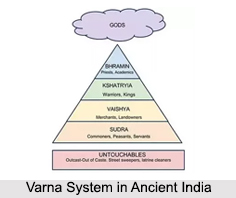
Varna System in Ancient India formed the basic structure of Hindu society. It is among the world’s oldest forms of surviving social stratification. Varna system divided the society into four major sections based on the occupation of the people.
 Varna System in Ancient IndiaVarna System in Ancient India was based on occupation, but with time it turned to a rigid caste system. ‘Varna’ literally means group in Sanskrit. With the advent of the Aryans, the ancient Indian society got divided into four sections - Brahmin, Kshatriya, Vaishya, and Sudra. In Hinduism, the Varna System was based on class, colour, guna, and yoga.

The first 3 Varna is called twice born. It implies that they have come of age and are eligible to study Sanskrit and the Vedas and perform Vedic rituals. The thread ceremony marks the second birth among the Indian male. For girls it is during their marriage that a thread is tied round their hands to mark the second birth. Besides Hindus, this custom is also prevalent with the Jains.