Showing posts with label empire. Show all posts

Monday, 22 July 2024

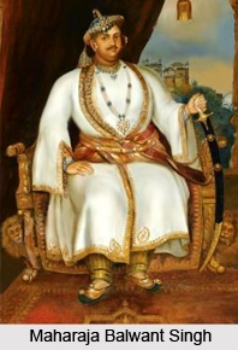
Balwant Singh: The Ruler of Bharatpur


Balwant Singh, a significant figure in the history of Bharatpur, was the Maharaja who ruled over the princely state of Bharatpur in Rajasthan during the late 19th century and early 20th century. His reign, from 1887 to 1918, was marked by both administrative reforms and military prowess, positioning Bharatpur as a formidable state amid the British colonial landscape. Balwant Singh's legacy is characterized not only by his governance but also by his conflict with British authorities and his efforts to modernize his state.

Born in 1865, Balwant Singh belonged to the Jat royal family, which had a long-standing history in the region, tracing its roots back to the Jat power established by Suraj Mal in the 18th century. Balwant Singh ascended to the throne at a young age following the death of his father, Maharaja Kishan Singh. As a ruler, he inherited the complexities of a state that was both strategically vital and embroiled in the socio-political dynamics of colonial India.

Balwant Singh was known for his progressive attitude towards governance. He instituted various reforms aimed at modernizing the administration of Bharatpur. Understanding the need for effective governance, he emphasized the importance of law and order, education, and economic development. Under his rule, the state's infrastructure saw significant improvements, including the development of roads, irrigation systems, and public institutions. Balwant Singh also advocated for education, establishing schools and encouraging higher literacy rates among his subjects.

Despite his modernization efforts, Balwant Singh’s tenure was not without conflict. He displayed a strong sense of sovereignty and resisted British encroachment. The British authorities perceived him as a significant challenge, particularly due to his close ties with the Indian National Congress and his willingness to support the national movement, which sought to challenge colonial rule.

In the late 19th century, tensions flared as Balwant Singh took a stand against British interference in regional politics. His assertiveness culminated in the 1900 agitation, during which he resisted British attempts to impose their hegemony over Bharatpur. This defiance resulted in skirmishes with British forces, but Balwant Singh negotiated his way through these conflicts, maintaining the independence of his state, at least in a nominal sense.

Balwant Singh's contributions to Bharatpur extended beyond military and administrative realms. He was a patron of the arts and culture, recognizing the importance of fostering a rich cultural heritage. His court became a center for artistic endeavors, and he supported local artists and craftspeople, enhancing the cultural tapestry of the region.

Furthermore, Balwant Singh was instrumental in preserving the architectural grandeur of Bharatpur. The construction of significant structures during his reign, including palatial buildings and temples, reflected his commitment to preserving the heritage and identity of Bharatpur. Notably, he is remembered for promoting the famous Keoladeo National Park, a UNESCO World Heritage site, which is home to diverse avian life.

Balwant Singh's rule over Bharatpur stands as a notable chapter in the history of Rajasthan and India. His efforts to modernize the state while asserting its sovereignty against colonial forces left an indelible mark on the region. The balance he maintained between tradition and progress, as well as his commitment to cultural patronage, ensured that his reign was characterized not only by challenges but also by achievements that resonate in the annals of Bharatpur’s history. His legacy serves as a reminder of the complexities faced by Indian rulers during the colonial era and their persistent quest for autonomy in a rapidly changing world.




Wednesday, 17 July 2024

Sulaiman Khan Karrani: The Afghan Ruler of Bengal

Sulaiman Khan Karrani, a prominent figure in the history of medieval Bengal, was an Afghan noble who rose to power as the Sultan of Bengal in the 16th century. His reign marked a significant period of political upheaval and military conflict in the region, as he sought to establish and consolidate his authority over the diverse and fractious territories of Bengal.

Sulaiman Khan Karrani was born into the Karrani tribe, a Pashtun ethnic group hailing from the rugged mountains of present-day Afghanistan. The Karranis were known for their martial prowess and administrative skills, and Sulaiman Khan inherited these traits, which would shape his destiny as a powerful ruler in the Indian subcontinent.

Sulaiman Khan Karrani's ascension to the throne of Bengal came at a tumultuous time in the region's history. The decline of the Mughal Empire and internal strife among various regional powers created opportunities for ambitious leaders like Sulaiman Khan to seize power and carve out their own domains. He capitalized on these circumstances and established himself as the Sultan of Bengal in the early 16th century.

One of the defining features of Sulaiman Khan Karrani's rule was his military prowess and strategic acumen. He led several successful military campaigns against rival kingdoms and local chieftains, expanding his influence and extending his authority over large parts of Bengal. His skill as a military commander earned him the admiration of his followers and the fear of his enemies, solidifying his reputation as a formidable ruler in the region.

In addition to his military exploits, Sulaiman Khan Karrani was known for his administrative reforms and efforts to promote economic development in Bengal. He introduced measures to improve governance, encourage trade, and stimulate agriculture, bringing a degree of stability and prosperity to his realm. His policies helped create a conducive environment for commerce and cultural exchange, attracting traders and artisans from various parts of the subcontinent and beyond.

Despite his achievements, Sulaiman Khan Karrani's reign was not without challenges. He faced resistance from rival factions, internal dissension, and external threats from neighboring powers, including the expanding Mughal Empire under Emperor Akbar. The conflicts and power struggles that ensued took a toll on Bengal and weakened Sulaiman Khan's grip on power.

Ultimately, Sulaiman Khan Karrani met his downfall in a decisive battle against the Mughal forces led by Emperor Akbar. The Battle of Tukaroi in 1575 proved to be a turning point in Bengal's history, as Sulaiman Khan was defeated and killed in the conflict. His defeat marked the end of the Karrani dynasty's rule in Bengal and paved the way for Mughal dominance in the region.

Sulaiman Khan Karrani's legacy as a dynamic and ambitious ruler continues to be remembered in the annals of Bengal's history. His contributions to the political and military landscape of the region, as well as his efforts to promote administrative reforms and economic growth, leave a lasting imprint on the history of medieval Bengal. Though his reign was marked by conflict and turmoil, Sulaiman Khan Karrani remains a figure of historical significance, embodying the complex and dynamic nature of power and politics in the Indian subcontinent during the 16th century.


Saturday, 6 July 2024

Exploring the History and Legacy of Singhana II


Singhana II, also known as Singhana II Devaganga, was a prominent ruler of the Western Chalukya dynasty who reigned during the 12th century. His rule marked a period of significant political and military achievements for the Chalukya Empire, and he is remembered as a capable and strategic monarch. Let's delve into the history, origin, and legacy of Singhana II in this article.

Singhana II belonged to the illustrious Western Chalukya dynasty, which was established in present-day Karnataka by Pulakeshin I in the 6th century. The Chalukyas were known for their military prowess, administrative efficiency, and cultural patronage. Singhana II ascended to the throne of the Chalukya Empire following the death of his predecessor Vikramaditya VI.

Singhana II's reign was characterized by his military expeditions and territorial expansions. He led several successful campaigns against rival kingdoms and neighboring powers, expanding the boundaries of the Chalukya Empire. Singhana II's strategic acumen, skilled generalship, and diplomatic finesse played a crucial role in the empire's military successes.

Under Singhana II's leadership, the Chalukya Empire consolidated its control over vast territories in South India, including parts of present-day Karnataka, Maharashtra, and Andhra Pradesh. His military campaigns were aimed at asserting Chalukya supremacy, securing trade routes, and quelling internal rebellions to ensure stability within his realm.

Administrative Reforms and Governance: Singhana II was known for his administrative reforms and efficient governance. He implemented policies to promote economic prosperity, agricultural development, and trade within the Chalukya Empire. Singhana II's emphasis on good governance and public welfare endeared him to his subjects, earning him a reputation as a just and benevolent ruler.

The period of Singhana II's rule witnessed a flourishing of art, literature, and culture within the Chalukya Empire. He was a patron of the arts and supported the construction of temples, monuments, and educational institutions. Singhana II's cultural patronage contributed to the artistic and intellectual vibrancy of his kingdom.

Singhana II's reign is remembered as a golden age in the history of the Western Chalukya dynasty. His military conquests, administrative reforms, and cultural patronage strengthened the foundations of the empire and left a lasting impact on the political landscape of South India. Singhana II's legacy endured beyond his lifetime, as subsequent rulers of the Chalukya dynasty sought to emulate his achievements and preserve the empire's heritage.

In conclusion, Singhana II Devaganga was a remarkable ruler of the Western Chalukya dynasty whose reign was marked by military triumphs, administrative prowess, and cultural patronage. His contributions to the history, origin, and cultural legacy of the Chalukya Empire are significant, underscoring his enduring impact on the historical narrative of South India during the 12th century.